Offices and assignments
Match staffing and assignment rules to a contractor office.
6 questionsPractice set
Free preview: 25 questions. View study pass options for full access.
Included with the Texas Environmental Air Class A study pass
Preview the printables below. Study pass holders can get the full PDFs from account downloads.
Quick review sheet
Review eight worked examples from the published practice sets.
Fold-and-review flashcards
Cut out the 24 rows and fold each down the center to hide the answer.
50-question practice workbook
Answer each question on paper, then use the explained key to review missed topics.
Study plan and score tracker
Choose a practice topic for each session and record your next step.
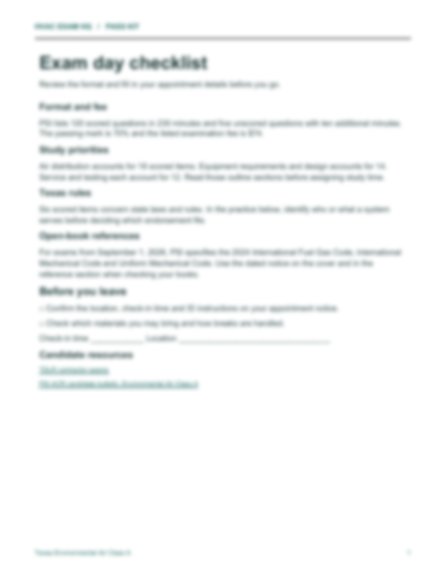
Exam day checklist
Review the format and fill in your appointment details before you go.
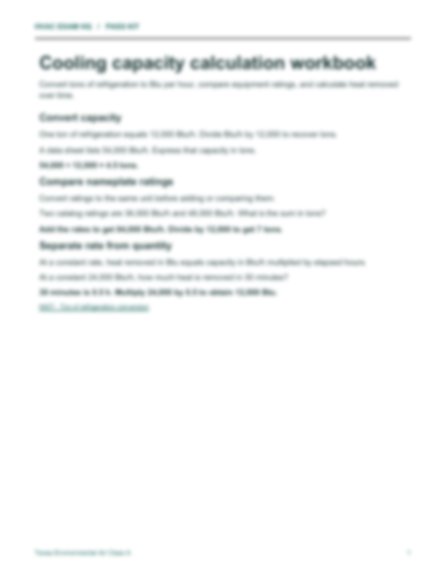
Cooling capacity calculation workbook
Convert tons of refrigeration to Btu per hour, compare equipment ratings, and calculate heat removed over time.
A rectangular duct has clear inside dimensions of 18 by 10 inches. At an assumed uniform flow of 900 cubic feet per minute, what average velocity does that imply?
The area is 180 square inches. Divide by 144 to get 1.25 square feet, then divide 900 by 1.25 to get 720 feet per minute. Check the units by multiplying 720 feet per minute by 1.25 square feet to recover 900 cubic feet per minute.
Further reading: Measuring Mechanical Ventilation Airflow
647 questions in the complete bank. The public preview includes 25 questions across the study topics.
Practice Texas contractor law in six-question forms
Take the 18-question air distribution test
Texas HVAC Class A airflow practice
Match staffing and assignment rules to a contractor office.
6 questionsDistinguish capacity limits from the type of work authorized.
6 questionsApply qualification, endorsement and disciplinary provisions.
6 questionsWork from a steady rate, a total and elapsed time. Check the units in each answer.
18 questionsRead flow reports, check duct units and compare how capture hoods measure air at a terminal.
12 questionsConvert clear dimensions into square feet and solve for air volume or velocity.
18 questionsTrace heat and refrigerant on heat-pump diagrams in cooling and heating modes.
9 questionsRead insurance certificates, distinguish local permit fees and apply Texas contractor and technician rules to written cases.
12 questionsInterpret saturation, superheat and subcooling reports, pressure references and heat per pound.
18 questionsIdentify heat sources, interpret cold-weather performance and distinguish zone heating from outdoor-air delivery.
12 questionsRead model-specific sensor schedules, mixed-air targets and controller event logs.
9 questionsInterpret controller trends for cooling requests, damper feedback, exhaust and sensor status.
10 questionsCompare exhaust, central fan supply and balanced recovery systems using DOE residential case guidance.
12 questionsInterpret combustion-air paths, room pressure and separation on residential heating plans.
8 questionsRead the OSHA incident record and annual summary requirements for covered employers.
8 questionsInterpret balancing valves, flow measurement and submittals using UFC 3-410-01 as the stated project criterion.
10 questionsReview appliance vent and dryer exhaust drawings under the federal manufactured-home standards, 24 CFR 3280.708 and 3280.710. These cases supplement the Texas venting topic.
10 questionsEvaluate appliance vent exemptions, documentation and location under the 2024 UMC.
8 questionsRead draft-system, pressure-zone and chimney submittal cases under the 2024 UMC.
7 questionsRead original plenum material and duct sizing submittals against the 2024 UMC.
6 questionsEvaluate duct supports, clearances, risers and access in Chapter 6 of the 2024 UMC.
9 questionsPractice 2024 umc appliance design review with original drawing and submittal cases based on Chapter 9.
9 questionsCheck 2024 umc air-conditioning equipment selection decisions using the published requirements in Chapter 9.
6 questionsPractice duct support and flood-zone plan review with original drawing and submittal cases based on Chapter 6.
11 questionsCheck duct leakage and air-path review decisions using the published requirements in Chapter 6.
11 questionsPractice duct insulation and damper selection with original drawing and submittal cases based on Chapter 6.
11 questionsCheck damper access and supply-air paths decisions using the published requirements in Chapter 6.
11 questionsRead project test results using the indicated federal UFGS 23 05 93 specification. Cases assume the project retained each cited provision.
9 questionsRead project test results using the indicated federal UFGS 23 05 93 specification. Cases assume the project retained each cited provision.
15 questionsReview stationary-system refrigerant records and service classifications against EPA Section 608 guidance.
12 questionsReview stationary-system refrigerant records and service classifications against EPA Section 608 guidance.
12 questionsInterpret original vapor and liquid temperature records using the supplied dew and bubble references. All pressure-to-temperature conversions and project acceptance ranges are supplied.
14 questionsInterpret original design scenarios against the project-specific provisions of UFC 3-410-01 (Change 1).
8 questionsInterpret original design scenarios against the project-specific provisions of UFC 3-410-01 (Change 1).
14 questionsPractice condensate waste and overflow plans with original drawing and submittal cases based on Chapter 3 and 12.
11 questionsCheck hydronic equipment and piping identification decisions using the published requirements in Chapter 3 and 12.
11 questionsPractice indoor combustion-air method selection with original drawing and submittal cases based on Chapter 7.
11 questionsCheck combined and mechanical combustion-air design decisions using the published requirements in Chapter 7.
11 questionsReview general-industry HVAC maintenance plans under 29 CFR 1910.147. Scenarios concern equipment maintenance under that standard.
22 questionsRead refrigeration component selection, performance and control scenarios using Copeland’s system design guidance.
9 questionsRead refrigeration component selection, performance and control scenarios using Copeland’s system design guidance.
12 questionsInterpret original design scenarios against the project-specific provisions of UFC 3-410-01 (Change 1).
16 questionsInterpret original design scenarios against the project-specific provisions of UFC 3-410-01 (Change 1).
8 questionsApply the fan laws to one unchanged fan, system and air density. Estimate how speed affects delivered flow, static pressure, shaft power and energy.
15 questionsPractice refrigeration equipment, access and drainage with original drawing and submittal cases based on Chapter 11.
11 questionsCheck refrigeration machinery-room ventilation decisions using the published requirements in Chapter 11.
11 questionsInterpret original operating records and duct designs using the DOE and AMCA fan system sourcebook.
8 questionsInterpret original operating records and duct designs using the DOE and AMCA fan system sourcebook.
8 questionsInterpret compressor service records and control diagrams using the Copeland refrigeration manual.
10 questionsInterpret compressor service records and control diagrams using the Copeland refrigeration manual.
6 questionsInterpret original design scenarios against the project-specific provisions of UFC 3-410-01 (Change 1).
12 questionsInterpret original design scenarios against the project-specific provisions of UFC 3-410-01 (Change 1).
10 questionsInterpret original refrigerant state records, calculate coil loads and compare energy across a heat exchanger.
9 questionsInterpret original design scenarios against the project-specific provisions of UFC 3-410-01 (Change 1).
12 questionsInterpret original design scenarios against the project-specific provisions of UFC 3-410-01 (Change 1).
8 questionsPractice gas branch and equipment inspection with original drawing and submittal cases based on Chapter 13.
10 questionsCheck fuel gas pressure and leak-test records decisions using the published requirements in Chapter 13.
10 questionsEvaluate installed filtration and interpret return-air performance using the EPA technical guide.
13 questionsEvaluate installed filtration and interpret return-air performance using the EPA technical guide.
2 questionsInterpret original heat-pump and chiller records using the DOE heat pump design guide.
10 questionsInterpret original heat-pump and chiller records using the DOE heat pump design guide.
7 questionsInterpret original HVAC records on a project using the cited federal design or testing criteria.
2 questionsInterpret original HVAC records on a project using the cited federal design or testing criteria.
5 questionsTDLR uses both license class and endorsement to select a contractor exam. Environmental Air A covers comfort conditioning and allows work on units of any size.
PSI lists 120 scored questions in 230 minutes and five unscored questions with ten additional minutes. The passing mark is 70% and the listed examination fee is $74.
Air distribution accounts for 18 scored items. Equipment requirements and design accounts for 14. Service and testing each account for 12. Read those outline sections before assigning study time.
Six scored items concern state laws and rules. In the practice below, identify who or what a system serves before deciding which endorsement fits.
For exams from September 1, 2026, PSI specifies the 2024 International Fuel Gas Code, International Mechanical Code and Uniform Mechanical Code. Use the dated notice on the cover and in the reference section when checking your books.